Electronic Request
Company: MyOrb Limited
Project Type: Web Application (Cloud-based, B2B Healthcare)
Role: Lead Designer
Project Main Goal
.png)
The main goal was to design a digital solution to replace paper-based NHS processes, enabling GPs and doctors to efficiently create, track, and manage patient diagnostic imaging requests and reports while improving speed, accuracy, and patient outcomes.
Discovery
During the discovery phase, workshops and user interviews with NHS stakeholders, GPs, and doctors helped uncover current workflows, challenges, and constraints. This allowed key pain points to be identified and aligned with clear project goals.
“Good digital tools should help us focus more on patients, not paperwork.”
NHS GP
Jobs
-
Create and submit patient requests quickly and accurately
-
Track the progress of requests across hospital systems
-
Collaborate with other clinicians and departments efficiently
-
Ensure patient pathways are followed without delays or gaps
Pain Points
-
Paper-based requesting processes were slow and inefficient
-
Lack of visibility over patient request status across departments
-
Inconsistent workflows between different medical specialties
-
High risk of delays and errors in manual data handling
Requirements
-
Digital replacement for paper-based request forms
-
Ability to create, track, and manage patient requests in real time
-
Structured workflows with clear stages (draft, review, finalised)
-
Flexible system supporting multiple departments (e.g. radiology, cardiology, dentistry)
Gains
-
Faster and more efficient request creation and processing
-
Improved visibility and transparency across patient journeys
-
Reduced errors through structured and standardised inputs
-
Better coordination between clinicians and hospital departments
Defining
Now that all research insights had been gathered from workshops and user interviews, the findings were synthesised to define the core problem areas and align on priorities.
From this, the end-to-end workflow was mapped out in the form of flowcharts, translating complex clinical processes into a clear structure.
This helped visualise how users move through the system, highlight inefficiencies in the existing process, and establish a shared understanding of how the digital solution should function.
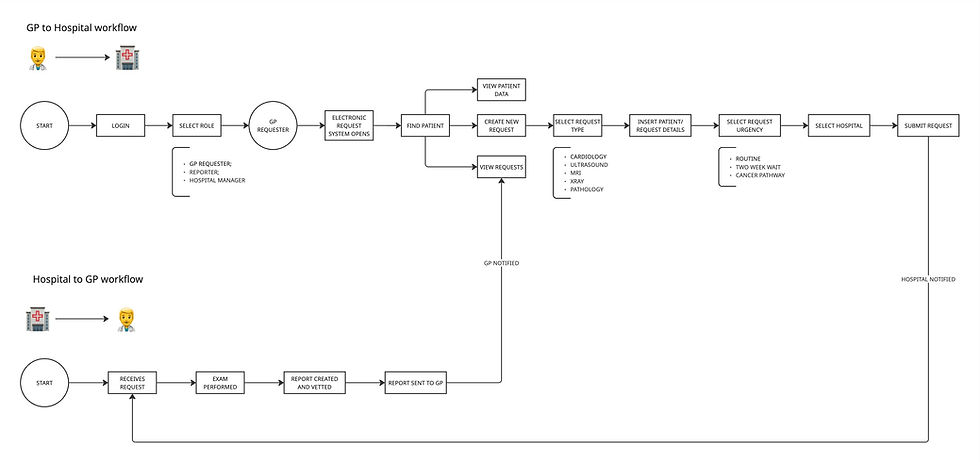
Problem
Paper-based NHS requesting processes were slow, fragmented, and lacked visibility across patient journeys.
GPs and doctors had no efficient way to create, track, or manage patient requests in real time, leading to delays, inconsistencies between departments, and limited oversight of patient pathways.
This resulted in reduced efficiency, increased administrative burden, and a risk of patients (particularly those on complex pathways such as cancer care) being missed or delayed in the system.
Solution
A digital electronic requesting system was designed to replace paper-based NHS processes, enabling GPs and doctors to create, track, and manage patient requests in a single platform.
The workflow streamlined the process from request creation to reporting, with automatic notifications when results were ready to support faster clinical decisions.
1) Once logged in, GPs use the “Find Patient” feature to quickly locate the correct patient and access their medical record and relevant data.
.png)
.png)
2) From the patient profile, doctors can view all past, current, and requested examinations, giving full visibility of the patient’s history and ongoing care.
3) Doctors can then create a new request by completing a structured form with the required clinical and administrative information.
.png)
.png)
4) Once completed, the request is submitted into the Hospital system, triggering the appropriate workflow for processing.
5) After the examination is completed and the report is ready, the GP is notified. They can then access the report directly and use it to support a timely diagnosis and next steps in patient care.
.png)
Design Testing

The designs were tested iteratively throughout multiple stages of the project to ensure usability and alignment with clinical workflows.
Early concepts were first validated using low-fidelity wireframes and flow diagrams, helping to confirm structure and user journeys before moving into detailed design.
As the designs progressed, interactive prototypes were created and tested with GPs and doctors through usability sessions.
This allowed us to observe how users interacted with key tasks such as creating and managing patient requests, and to identify friction points early.

MVP Testing
For the MVP testing phase, I worked in collaboration with doctors and the development team to define realistic testing scenarios that reflected actual clinical workflows while remaining aligned with technical constraints.
This ensured the system could be properly validated in a live hospital environment.
Feedback from each round of testing was used to refine and improve the design, ensuring the final solution was intuitive, efficient, and aligned with real clinical needs before launch.